
You know the feeling. You walk into the gym wearing the Nike shoes you were out in at the bar last night. Or you switch your shoes for a pair of flat Vans or All Stars… Maybe you even take your shoes off for certain exercises. Does it even matter? Read all about shoes for strength training in this article.
Over the years, as a strength athlete, you gather more and more knowledge. You delve into nutrition, supplements, training principles, and more. The appearance in the gym also becomes increasingly important. However, there is one topic that is often overlooked, namely: footwear.
In this blog, we will talk about shoes and strength training. We will discuss different exercises and how shoes can affect them.

There are various exercises where shoes affect your execution and the muscles you want to engage. These include:
- Squat
- Deadlift
- Leg press
- Press exercises (bench press, shoulder press, etc.)
- Cardio
Squat
Perhaps the most obvious leg exercise. Especially when you start squatting heavier, shoes make a difference. You see everyone trying all sorts of things; squatting with heels on plates, barefoot, on raised soles, different widths in stance, and so on.
When it comes to shoes for strength training, you can mainly go in two directions. For both variants, you want to have little cushioning in your sole. The more cushioning you have in the sole, the more you have to push through the sole, which comes at the expense of your stability and the power you can deliver. Because you lose stability, cushioned shoes also put much more strain on your ligaments, making it much more injury-prone. So do not squat in your running shoes!!!
First of all, the raised heel
By raising your heels, you not only change the angle in your ankle, but also the angle in your knee and hip changes accordingly. Mainly your knee creates a greater flexion moment (it bends more). Due to this bending, the muscle that extends the knee has to work hardest to come back up in your squat. These are the quadriceps (thigh muscles). So if you want to squat dominantly on your quadriceps, use shoes that have a raised heel. There are special shoe models for this, which we also call ‘Lifters’ or ‘weightlifters’.
A second variation of the squat is squatting with flat soles
It is important that a shoe has a low heel lift! Heel lift is the ratio of the heel being higher than the forefoot. With a flat sole, your knees lock out more easily, resulting in less knee flexion. This automatically means you have to get more range of motion from your hips, which leads to more stretch in your hamstrings and glutes. So if you want to squat dominantly with your glutes and hamstrings, use flat shoes! There are even special shoes designed for strength training for this purpose, like my own brand; Artin Athletics
Deadlift
For a good deadlift, there is really only one type of shoe you want to use: a shoe with a low heel lift and room for your toes. The thinner the sole, the closer you stand to the bar. This shortens the distance the bar has to travel, making it easier to lift heavy. A low heel lift is also important because you pull the bar 'backwards.' If your heel lift is high, you have to lift the bar uphill, which makes it much harder to succeed in your lift!
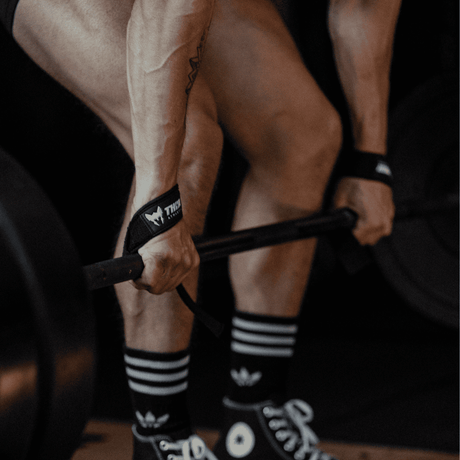
For heavy lifts, it is important to choose shoes with plenty of toe room. When a lot of weight is on your feet, your feet need the ability to spread out and distribute the pressure. Shoes with narrow toes (think Vans, All Stars) squeeze your feet together, which compromises your stability and foot tension.

In short; use shoes with thin soles and low heel lift, stand as close to the bar as possible, and you will undoubtedly set new records!
Leg press
The leg press works exactly the same as the squat, but you perform the movement in reverse. High heels activate your quadriceps, while low heels activate your hamstrings and glutes more.
You can also play with the width of your feet to shift your focus a bit more. The narrower you place your legs, the more you limit your hips and thus engage your knees more. The wider you place your legs, the more you 'open' your hips and can engage your hamstrings and glutes more.
I don’t swear by a specific type of shoe; there’s actually a difference depending on what you want to focus on. Just don’t do your leg days in cushioned running shoes..!
Press exercises
I can hear you thinking already; ‘What difference does it make what shoes I wear when I’m doing a shoulder press?’
Now, this is a very interesting one. We’ll start with the seated exercises. Think mainly of bench pressing and the shoulder press.
These exercises are not isolation exercises but compound exercises where we use our whole body. We use a phenomenon called ‘leg drive.’ We use this leg drive to firmly set our upper back on the bench and increase our core stability and stiffness. This gives us the ability to generate as much strength as possible from the muscles we mainly use (in this case chest or shoulders).
In terms of footwear, it’s important not only to have stability for your feet but also to use shoes with a lot of grip. When your feet slip, it’s much harder to perform a press exercise.
Then we have the standing exercises, think for example of the military press, clean and jerk, or snatch. These are biomechanically a bit more complex.
What you actually want here is an elevated heel. That’s because an elevated heel pushes your hips forward. When you push your hips forward, it’s easier to push the upper half of your torso back, which makes it easier to press a weight overhead. Still with me?

Another example you’ve probably seen or maybe you do it yourself: excessively arching your lower back during an overhead press when you just can’t quite finish that last rep. Simply put: you push your hips forward to make it easier to press something overhead.
Cardio
With cardio, we will mainly be talking about running. This is the most obvious form of cardio and it’s the best way for me to explain why you shouldn’t use running shoes for strength training and why you shouldn’t use fitness shoes for running.
When running, you make a movement at speed: you push off, float for a moment, and then land on your other foot again. This is, of course, a completely different load than in strength training, where you mainly move very statically.
When running, each step puts more than twice your body weight on your leg. The load on your legs is therefore enormous.
What you mainly need at landing is cushioning. To absorb the impact of your body weight each time, your muscles and tendons have to work very hard. They get a beating with every step. Especially your shin muscle (tibialis anterior) and your thigh muscle (quadriceps) take a lot of strain. When you have little cushioning, this can lead to shin splints.
So you want a thick sole with a cushioned heel. It also helps if the heel is somewhat rounded at the back. These are all tricks used in running shoes to reduce the impact during landing.
In addition, pushing off with your feet is also an important factor during running. To support this, shoes often have a ‘rolling’ sole.
How do you recognize such a rolling sole?
These shoes have toes that curve upward significantly. This rolling motion is also called the rollover. Our foot normally mainly uses the big toe to roll over, but if a shoe can help with that, it’s certainly desirable, right!? That way, you waste less energy yourself.
Conclusion: shoes for strength training
It definitely matters which shoes you use in the gym. You can even get so specific that you use a different pair of shoes for each exercise. Of course, that’s not very realistic.
I hope I was able to share some knowledge about shoes for strength training. Be sure to also check out our website and Instagram of Artin Athletics.
Best regards,
Joris van Gerven
Co-owner of Artin Athletics & Orthopedic Shoe Technologist